Across the globe, more students are choosing online learning as part of their high school journey. If we’re right, you are probably looking for Grade 10 courses online—perhaps for greater flexibility or to boost your GPA for university. If that’s the case, one course you’ve likely heard about is Grade 10 Math Ontario (MPM2D), which is part of the academic stream in the Ontario grade 10 math curriculum.
While taking math as an online course seems like a flexible option for some students, it may bring up questions surrounding whether the material is manageable on your own, will you fall behind without a teacher nearby, or even how different is it from learning in a traditional classroom.
However, rest assured because taking MPM2D online is definitely achievable for many students. While it involves some changes in how you approach your studies, it’s far from impossible. In this guide, we will help answer the most common questions you have about the MPM2D curriculum in an online format and explain what you can realistically expect.
What is Grade 10 Math Ontario (MPM2D)?
In the Ontario curriculum, the Principles of Mathematics 10—known by its course code MPM2D—is part of the Ontario grade 10 math curriculum. The idea is to build directly on knowledge and skills from Grade 9 and introduce several new concepts that will appear again in successive grades of Grades 11 and 12.
Students enrolled in Grade 10 Math Ontario (MPM2D) typically study topics such as:
- Quadratic relations and how to graph parabolas
- Factoring expressions and solving quadratic equations
- Trigonometric ratios to solve problems involving triangles
- Understanding transformations of functions
While the material does expand on Grade 9 math, it’s designed in a way that is approachable for students who have finished the earlier course. The principles of math 10 is focussed on developing students’ problem-solving abilities and logical thinking.
How Does Taking MPM2D Online Work?
One of the most significant differences when choosing an grade 10 math course online is the medium of instruction and support. Here’s how it typically looks:
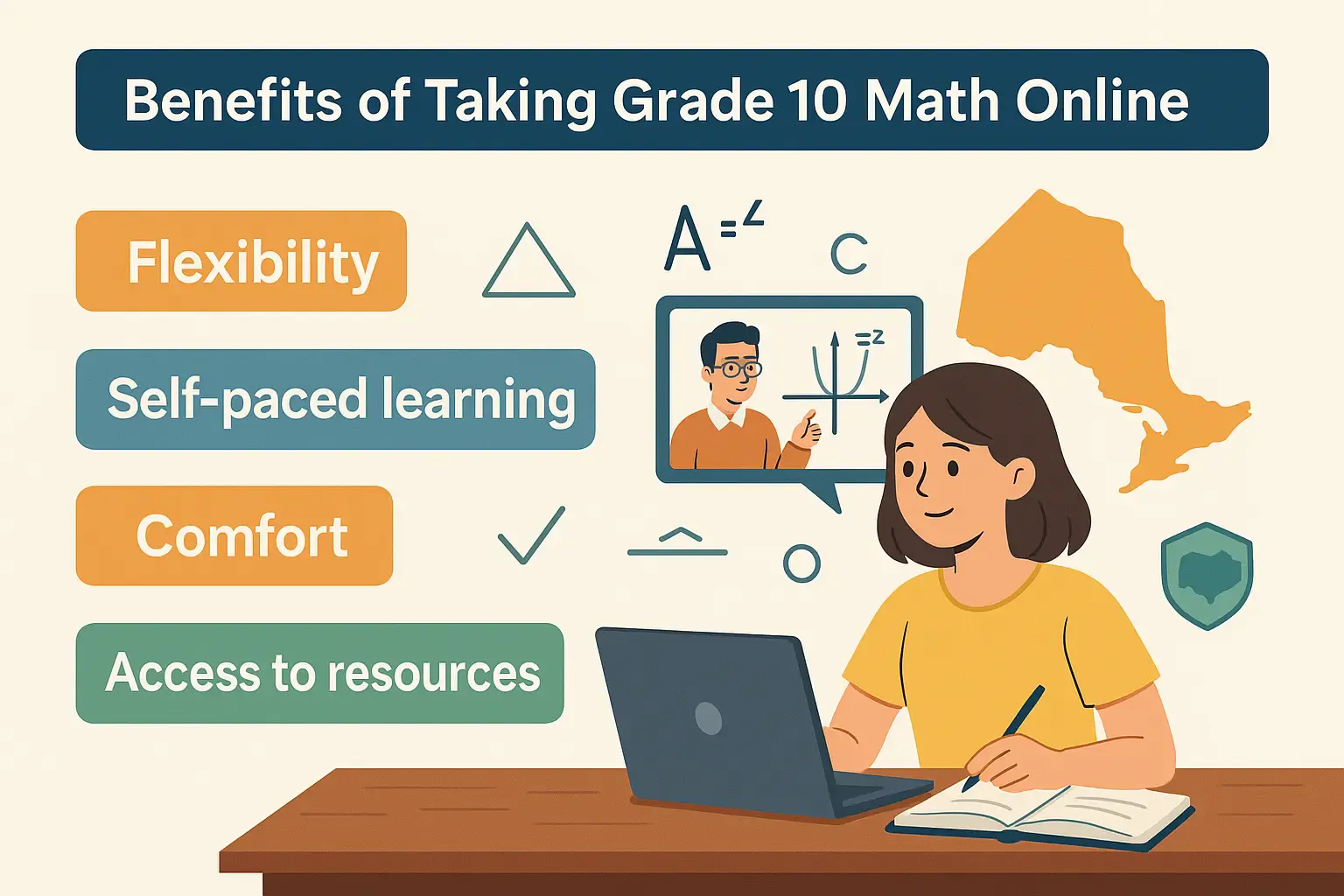
- Flexible pacing: Online courses often allow students to finish their lessons at their own speed. This strategy works well for students who want to spend more time on challenging topics or those who want to move quickly through material they already understand.
- Digital resources: The level of interaction in Online classes is enhanced through videos, interactive exercises, and digital quizzes. These tools help explain concepts visually and allow for practice and self-assessment.
- Communication with teachers: In an online MPM2D curriculum, students still have access to qualified teachers. Communication might happen through email, virtual meetings, or discussion boards. Teachers provide feedback on assignments and answer questions.
- Independent learning: Students are responsible for managing their schedule, submitting work on time, and reaching out when they need help.If you’re exploring online options for a grade 10 math course, it can be helpful to look into schools and programs that specialize in Ontario’s curriculum. For instance, Canadian Grad Academy offers online courses and resources designed specifically for Ontario high school students, helping bridge the gap between traditional classrooms and online learning.
Is Grade 10 Math Hard?
“Hard” is always relative, but when parents and students ask whether the grade 10 math curriculum is harder, what they’re really getting at is: “What exactly will I be expected to master, and how steep is the learning curve?” So let’s break the MPM2D curriculum down by its official curriculum pieces :
- Quadratic Relations – It’s the first time math class asks you to think in arcs instead of straight lines, and you have to stretch your brain a bit. You’ll learn to shift between the three dialects of a quadratic—standard (y = ax² + bx + c), factored, and vertex form—because each one highlights different information (roots, intercepts, or the turning point).
- Analytic Geometry – Remember drawing a line through two points in Grade 9? Now you’ll prove why that line is parallel to another, measure how far it runs, and locate its exact midpoint—all with algebra instead of guess-and-check. The good news: every new proof starts with skills you already own (slope, intercepts, basic coordinate rules).
- Trigonometry of Right Triangles – The big ideas you’re going to tackle include sine, cosine, and tangent to solve 2-D problems. You’ll solve composite right-triangle situations, convert between angle measures, and justify each step with similarity or the Pythagorean Theorem. Diagrams are mandatory; once the triangle is drawn, the ratio you need is usually obvious.
- Mathematical Processes – Throughout, marks reward clear reasoning as much as correct answers. Modelling, conjecturing, and communicating—stated explicitly in the curriculum can be extremely helpful serving as toolkit. Use it often enough and it becomes instinctive, a mental checklist that spots errors. All four strands extend Grade 9 ideas rather than replace them; consistent practice links the familiar to the new and turns “hard” into “handled.”
Overall, students who keep up with their work, ask questions promptly, and practice regularly typically do well in the principles of mathematics 10 course.